Capture FMCW chirps
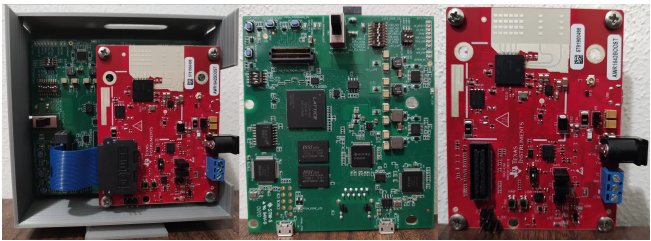
The TI AWR1642BOOST transmits frequency-modulated chirps sweeping 77 → 81 GHz. The echo off the chest comes back slightly delayed, and its phase encodes the chest's tiny back-and-forth motion.
Decode I/Q into frames
Raw binary radar data is loaded, the interleaved in-phase / quadrature samples are converted to complex numbers, and everything is reshaped into frames × chirps × ADC samples × virtual antennas.
Find the chest's range bin
A range FFT turns each chirp into a distance profile. We pick the bin containing the chest and tune it for every scenario, because even a small misalignment picks up background clutter instead of breathing.
Fuse the antennas
Each virtual antenna sees its own multipath and angle-dependent noise. Averaging the phase across all eight antennas, frame by frame, cancels much of that noise and keeps the shared chest motion.
Unwrap and detrend
Phase wraps around at ±π, so it is unwrapped to remove the jumps, then detrended to remove slow drift. What remains is the chest displacement signal itself.
Split into breath and heart
Band-pass filters matched to adult physiology separate the slow breathing rhythm from the much smaller, faster heartbeat. These two signals feed each of the three methods.